
Stays & neighborhoods / Accommodation comparison
Where to Stay in Seoul for First-Time Visitors
A neighborhood-by-neighborhood decision guide based on repeated journeys, airport access, station exits, hills, late nights, family needs, and total accommodation cost.
Myeongdong or Euljiro is a practical central base, Hongdae or Yeonnam favors airport rail and active evenings, Jongno or Insadong suits palace-focused trips, and Gangnam or Jamsil works when most plans are south of the river. Choose the exact property that shortens repeated journeys and remains easy after a delayed arrival.
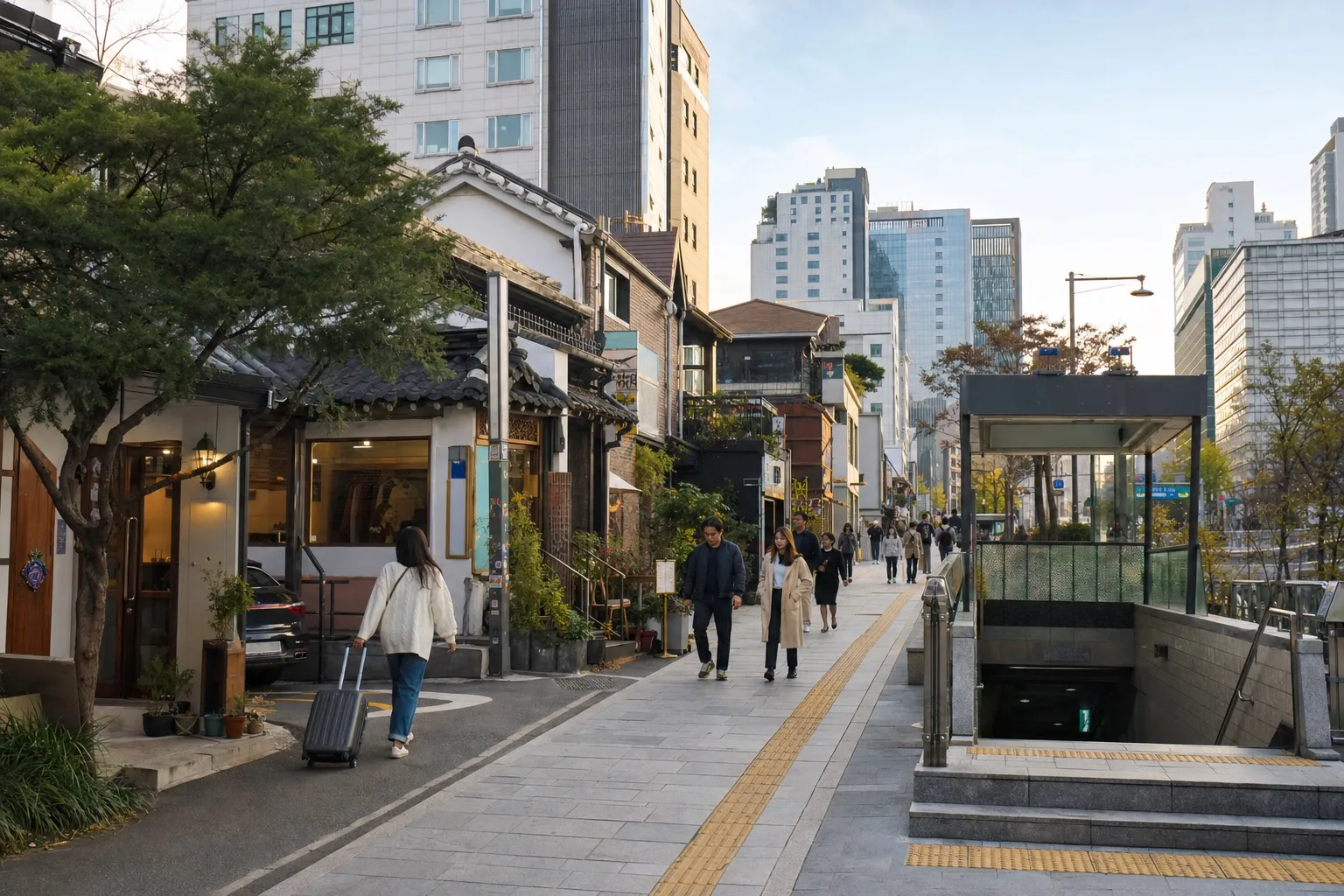
Before you decide
- Plot the five places you expect to visit most
- Count repeated crossings of the Han River
- Check the exact subway line and station exit
- Measure hills, stairs, underground corridors, and the luggage route
- Confirm late check-in and after-hours entry
- Compare the airport route after a one-hour delay
- Read recent reviews for the exact room type
- Compare taxes, breakfast, laundry, luggage storage, and cancellation
- Verify that a guesthouse or rental is lawfully listed where applicable
Best Seoul area by repeated trip pattern
| Area | Best for | Check before booking |
|---|---|---|
| Myeongdong / Euljiro | Broad central sightseeing and first-trip convenience | Exact line, exit, airport-bus stop, and room size |
| Jongno / Insadong | Palaces, museums, and traditional central Seoul | Late-night route and after-hours access |
| Hongdae / Yeonnam | Airport rail, dining, and active evenings | Large station, exit distance, and noise |
| Seoul Station / City Hall | AREX, KTX, and cross-city connections | Pedestrian route and surrounding block |
| Gangnam | Business and repeated southern-Seoul plans | River crossings and actual subway line |
| Jamsil | Families, events, and eastern Seoul | Airport and historic-center travel time |
| Itaewon / Yongsan | International dining and central geography | Hills, line access, and late-night noise |
| Dongdaemun | Late shopping and eastern central access | Station complexity and road crossings |
| Seongsu | Cafes, design, and eastern neighborhoods | Longer airport and palace-area journeys |
Choose a base by repeated travel
Plot the places you will visit more than once, then compare travel time from candidate properties. Saving ten minutes on four journeys matters more than being next to one attraction.
Do not choose only from a neighborhood label. A property marketed as Hongdae, Myeongdong, or Gangnam can be far from the station, on a hill, beside a noisy road, or connected to a line that does not serve your itinerary well.
Myeongdong and Euljiro: central first-trip convenience
This area suits travelers with sightseeing spread across central Seoul and both sides of the old city center. Visitor services, shopping, and multiple transport options make it a useful default.
Check the exact line and exit. Some properties are closer to Euljiro than Myeongdong Station, and the easiest airport route may be a bus stop rather than a rail transfer.
Jongno and Insadong: palaces and traditional central Seoul
Choose this area when palaces, Ikseon-dong, traditional streets, museums, and central neighborhoods dominate the plan. It can provide a calmer base while remaining close to major sights.
Late-night airport access and station depth vary by property. Measure the final walk and confirm after-hours entry rather than assuming every central hotel has a 24-hour desk.
Hongdae and Yeonnam: airport rail and active evenings
Hongik University Station offers direct airport-rail access and strong evening activity. It fits visitors who value restaurants, nightlife, and western Seoul.
The district is broad. Check which station exit serves the property, whether the airport-rail platform is a long underground walk, and whether recent reviews mention street or building noise.
Seoul Station and City Hall: connections over atmosphere
This area can simplify airport rail, KTX, and cross-city movement. It works well for a short stay with an early train or an itinerary that repeatedly changes regions.
The pedestrian environment differs by side of the station, and some routes involve large intersections or underground passages. Inspect the luggage route at the time you expect to arrive.
Gangnam: best when the itinerary is mainly south of the river
Gangnam is practical for business, clinics, shopping, and repeated plans in southern Seoul. It is a weaker default when most days focus on palaces and northern central districts.
The word Gangnam covers a large area. Confirm the subway line, transfers, airport route, and late-night return rather than choosing from the district name alone.
Jamsil: families, events, and eastern Seoul
Jamsil can suit families and travelers focused on major attractions, events, or eastern Seoul. Modern facilities and large properties can be convenient for groups.
It is farther from many historic sights and Incheon Airport. Compare the total cross-city time before accepting a lower room rate or larger room.
Itaewon and Yongsan: international services and central geography
These areas can suit travelers prioritizing international dining, nightlife, or destinations around Yongsan. Central geography does not always mean simple rail access to every sight.
Hills and late-night noise can vary sharply by street. Check the exact walking route, entrance, and recent room-specific reviews.
Dongdaemun: late shopping and eastern central access
Dongdaemun can work for late shopping, fashion areas, and transport links on the east side of central Seoul. It may fit an itinerary split between central and eastern districts.
Station complexes and road crossings can make a short map distance feel longer with luggage. Confirm which line and exit you will actually use.
Seongsu: cafes and local-style exploration
Seongsu appeals to travelers prioritizing cafes, design, pop-ups, and eastern Seoul. It is better as a deliberate lifestyle choice than as an automatic first-time base.
Popular venues change quickly, and airport or historic-center access may require more travel. Map repeated journeys before paying a premium for trend value.
Run the station and arrival-night tests
Measure the route from the correct platform or airport-bus stop to the property entrance. Look for elevators, stairs, hills, unpaved sections, and long underground corridors.
Then pretend the flight arrives one hour late. Confirm the remaining route, reception hours, after-hours access, and the cost of the fallback vehicle. Save the property name, Korean address, phone number, and entry instructions offline.
Compare the complete accommodation cost
Include taxes, breakfast, luggage storage, laundry, room size, cancellation flexibility, bedding for every guest, and repeated transport. A cheaper room can cost more overall when it adds long transfers or an expensive late-night arrival.
Use official tourism directories and current property records as a starting point, then verify the actual operator, address, and booking terms. SmartRoot Korea does not currently publish an unapproved hotel affiliate link.
Final recommendation
For a broad first itinerary, start with exact properties in Myeongdong, Euljiro, Jongno, or Insadong. Choose Hongdae when airport rail and evening activity matter more, and choose Gangnam or Jamsil only when southern or eastern plans justify the distance.
Area information and official accommodation resources were reviewed on 6 August 2026. Property operation, price, access, and legal status can change, so confirm the exact listing before payment.
Frequently asked questions
Is Myeongdong the best area for every first-time visitor?
No. It is a useful central default, but Hongdae, Jongno, Gangnam, or another area can reduce more travel for a specific itinerary.
Is Hongdae convenient from Incheon Airport?
It has direct airport-rail access, but the station is large. Check the exact exit, underground walk, elevator, and distance to the property.
Should I stay north or south of the Han River?
Stay near the side where most repeated plans occur. Frequent river crossings add time, especially when the itinerary is already spread across several districts.
How close should a hotel be to the subway?
Use the real walking route rather than a fixed number. An elevator route of several minutes can be easier than a shorter route with stairs, hills, or a long underground corridor.
What matters for a late arrival?
A route that still operates after immigration and baggage, confirmed reception or self-entry, and an affordable fallback. Test the plan with at least a one-hour delay.
How do I check whether a guesthouse is legitimate?
Start with official tourism or Seoul Stay listings where applicable, verify the operator and exact address, and review current booking and cancellation terms before paying.
Sources and verification
Continue this setup
Report an issue with this guide
https://app.smartroot.cloud/guides/where-to-stay-seoul-first-time
Open email draftNot sent until you send the email. No passport, card, or private account details.